Traffic staging plans & CAD staging sets
One TGS is straightforward. A dozen, changing week to week, is a different problem entirely.
For projects that require multiple, evolving Traffic Guidance Schemes, Sightline delivers an in-depth staging service built for complexity. Our engineers and project managers are qualified across a wide range of traffic and roadwork scenarios, advising with practicality in mind so the plan holds up when it actually meets the job.
What sets our staging approach apart
Built for complexity — civil infrastructure jobs with multiple, constantly changing TGS are coordinated smoothly, without losing accuracy or control
Revisions at construction pace — when the job changes, the affected sheets are revised and reissued through the drawing register, with revision history tracked sheet by sheet — not redrawn from scratch
One coordinated sequence — consistent drawing numbering, a key plan and shared conventions across every stage — one sequence instead of a dozen orphan TGS, and a more economical outcome than treating each phase in isolation
What a full CAD staging set includes
Complex infrastructure projects don't run on a single static plan. They move through multiple construction stages, each with its own traffic arrangement. Sightline prepares full CAD-based traffic staging sets — cover sheets, key plans, general notes and legends, typical details, general arrangement plans, and vehicle turn path plans — produced to Australian Standards and road authority drawing conventions.
Each set is built stage by stage, clearly showing what is under construction, what is complete, and what remains live traffic at every point in the project — so contractors, councils and road authorities can see precisely how the site will look and function at each phase.
Multi-stage projects get the same clarity and reliability as a single TGS — just scaled to handle the complexity of the job.
Related project evidence
Authorised project material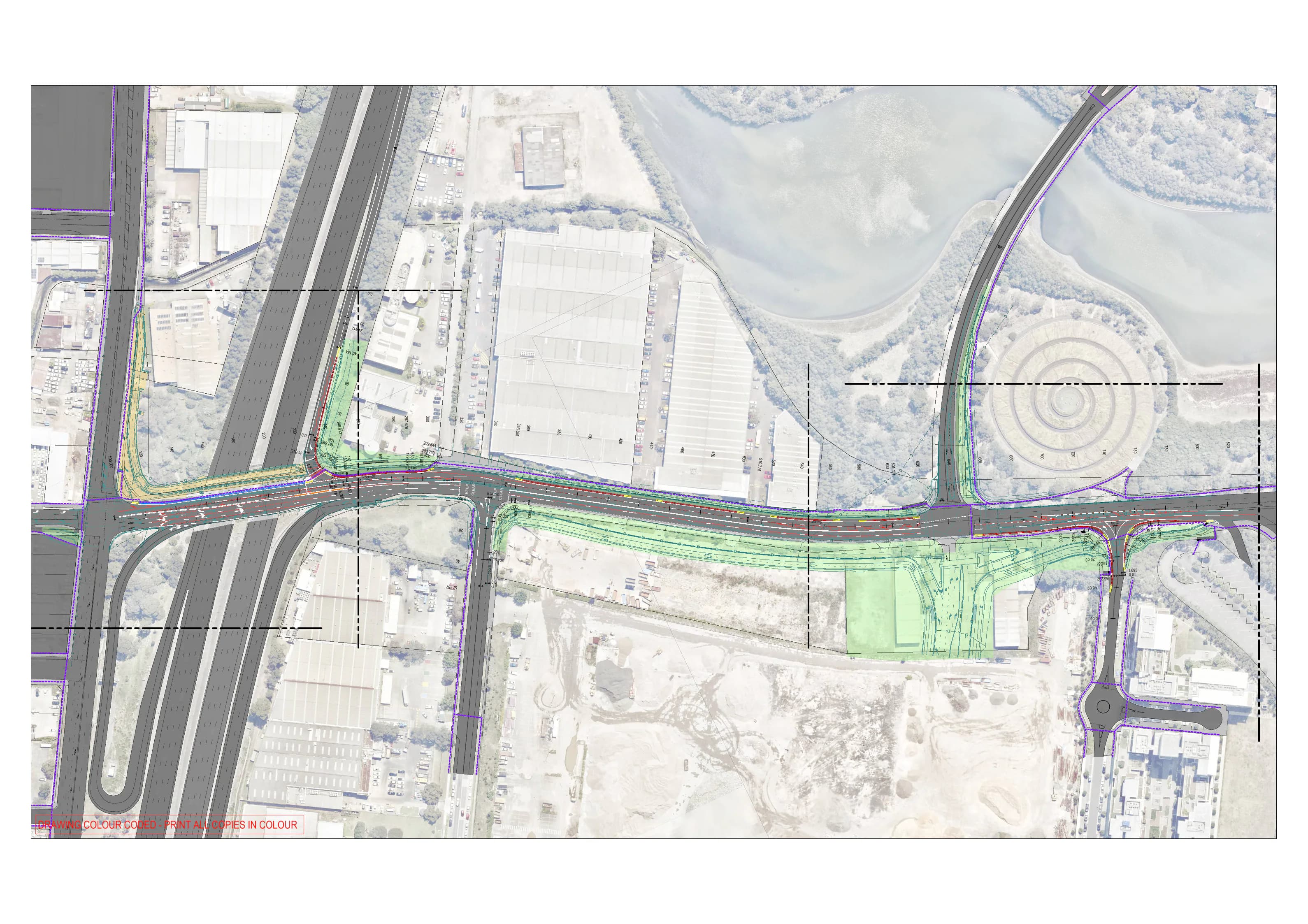 Overall traffic staging plan · View project →
See how the service is documented on a real project.
Hill Rd Traffic Staging
An overall corridor plan coordinating staged traffic arrangements, temporary alignments, work zones and tie-ins across Hill Road and its connecting intersections.
- Status
- Overall plan
- Shown
- Overall traffic staging plan
How the engagement moves
From enquiry to controlled issue- Step 01Send the project
Provide the site, available drawings and the issue that needs resolving.
- Step 02Confirm the scope
We identify the required assessment, documentation, programme and fee.
- Step 03Assess and coordinate
The technical work is developed against the project and authority requirements.
- Step 04Check and issue
The agreed review is completed before controlled issue and support through comments.
Common questions
When do I need a staging plan instead of a single TGS?
When your project moves through multiple phases with changing site conditions — common on larger civil or construction jobs — a staging plan coordinates a full sequence of TGS documents rather than treating each phase in isolation.
What's the difference between a traffic staging plan and a TGS?
A TGS covers a single point-in-time traffic arrangement. A staging plan set covers the full sequence of arrangements across a multi-stage project, tied together with consistent drawing numbering and a key plan.
Does a staging plan cost more than a single TGS?
It involves more upfront coordination, mapping multiple stages together — but it's designed to reduce costly rework and delays later in the project.
What software is used?
CAD (AutoCAD), to industry drawing standards and formatted for road authority and council submission.
Are turn path / swept path plans included?
Yes — vehicle turn path plans for the relevant design vehicles are typically included in a full staging set, or scoped separately.
How many stages can a set cover?
As many as the project requires — we have delivered multi-stage sets for complex intersection and bridge upgrade works involving several distinct construction stages.
Can staging plans be adjusted once the project starts?
Yes — our systems are built to manage high-workload, frequently changing projects, so plans are reviewed and adjusted as the job progresses.
Who approves these drawings?
Staging plans undergo internal design check and verification before submission, and are ultimately approved by the relevant road authority or council.
Send us the drawings. We'll tell you what you need.
2. Plans, if they exist
3. A description of the works
 Contact
plans@sightlinetraffic.com.au
Suite 413, 388 George St, Sydney NSW 2000
Mon–Fri, 8am–5pm
ABN 16 699 960 668