Traffic management plans (TMP & CTMP)
Working without one carries real risk — fines, stop-work orders, and liability if something goes wrong.
Sightline prepares Construction Traffic Management Plans (CTMP) and Traffic Management Plans (TMP) for projects across Sydney and NSW. A TMP is the strategic document setting out how vehicles, cyclists and pedestrians will be safely managed around a work site, event, or any activity that disrupts normal road conditions — mandatory for most civil works, developments and events affecting a public road, footpath or cycleway.
What a properly prepared TMP does
Protects vulnerable road users — pedestrians, cyclists, and mobility-impaired road users — with safe alternative routes
Keeps workers safe from live traffic and site vehicle movements
Maintains reasonable traffic flow for the public, minimising delay and disruption
Meets all relevant state and local requirements, including TfNSW codes of practice
When a TMP is required
Generally wherever a project will alter normal road, footpath or cycleway conditions for any duration; form part of a development application (DA) condition; require a Road Occupancy Licence or similar permit; or have a measurable impact on the surrounding road network due to its scale or duration.
What's inside a TMP
Site & hazard assessment — traffic volumes and patterns, nearby schools, hospitals and transport stops, sightlines and road geometry, and a risk matrix mapping hazards to controls
Traffic Guidance Scheme (TGS) — the visual component, prepared in line with the current Austroads Guide to Temporary Traffic Management
Implementation & monitoring plan — roles and responsibilities, set-up, modification and removal procedures, contingency plans, and ongoing inspections
TMP vs TGS vs VMP
TMP — the master strategy: full risk assessment, procedures, responsibilities and compliance framework
TGS (also called a Traffic Control Plan) — the visual blueprint traffic controllers use on the ground
VMP (Vehicle Movement Plan) — manages vehicle logistics inside the site boundary, distinct from the TGS's public road focus
Our process
- 01
Initial consultation & site assessment — scoping works and assessing road geometry, sightlines and existing activity
- 02
Risk assessment & strategy development — identifying hazards and developing controls in line with safety-in-design principles
- 03
TGS/VMP design — standards-compliant diagrams (AS 1742.3) showing signage, barriers, VMS and personnel
- 04
Documentation & submission — compiling and lodging a single compliant plan
- 05
Implementation & monitoring — pre-start briefings, on-site support, and ongoing review
Common mistakes we help clients avoid
Relying on a generic, non-site-specific template — every location has its own hazards a template can't account for
Overlooking pedestrian and cyclist provisions — a compliant TMP needs safe, accessible alternative routes
Treating a technically sound plan as “job done” — a TMP is only as good as its on-site implementation
Related project evidence
Authorised project material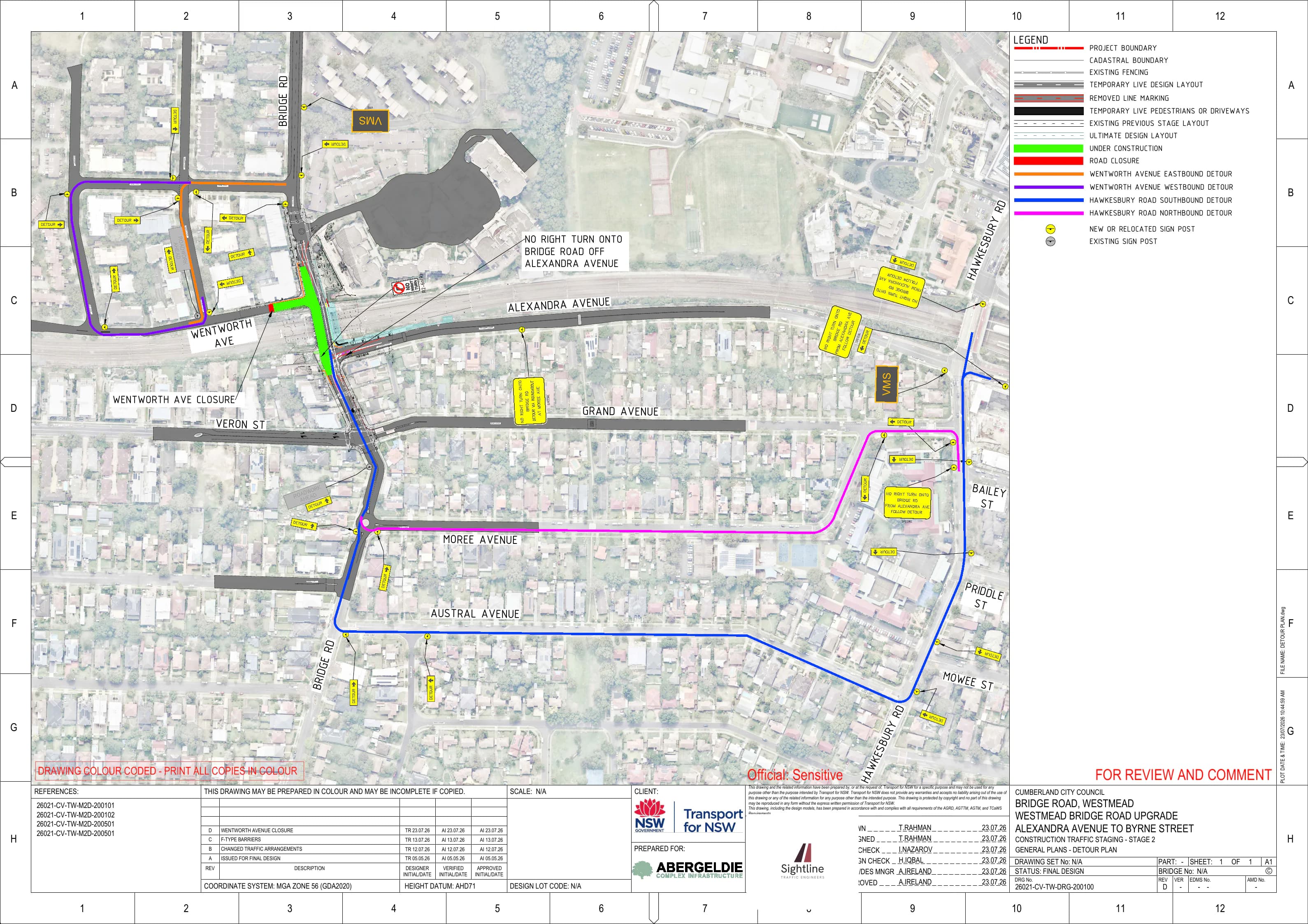 Stage 2 detour plan · View project →
See how the service is documented on a real project.
Westmead Bridge Detour Plan
A Stage 2 detour drawing for the Westmead Bridge Road upgrade, routing traffic around the Wentworth Avenue closure between Alexandra Avenue and Byrne Street.
- Status
- Stage 2 - for review and comment
- Shown
- Stage 2 detour plan
How the engagement moves
From enquiry to controlled issue- Step 01Send the project
Provide the site, available drawings and the issue that needs resolving.
- Step 02Confirm the scope
We identify the required assessment, documentation, programme and fee.
- Step 03Assess and coordinate
The technical work is developed against the project and authority requirements.
- Step 04Check and issue
The agreed review is completed before controlled issue and support through comments.
Common questions
Who is qualified to design a TMP in NSW?
A Transport for NSW “Prepare a Work Zone Traffic Management Plan” qualification (equivalent accreditation applies in other states). Always engage an appropriately certified consultant.
What's the difference between a TMP and a TIA?
A TMP is an operational document for managing traffic around a temporary work site or event. A TIA is a strategic report for a DA, assessing a development's longer-term impact on the surrounding road network.
Can an approved TMP be changed once work starts?
Not without a formal amendment — the plan must be revised by a qualified designer and resubmitted for approval.
What standards apply?
AS 1742.3 for signs, devices and procedures, alongside the current Austroads Guide to Temporary Traffic Management and relevant authority requirements — in NSW, TfNSW TS 05492 Traffic Control at Work Sites, and the applicable TfNSW TS 03401 (G10) specification where required by the contract or road authority.
Send us the drawings. We'll tell you what you need.
2. Plans, if they exist
3. A description of the works
 Contact
plans@sightlinetraffic.com.au
Suite 413, 388 George St, Sydney NSW 2000
Mon–Fri, 8am–5pm
ABN 16 699 960 668